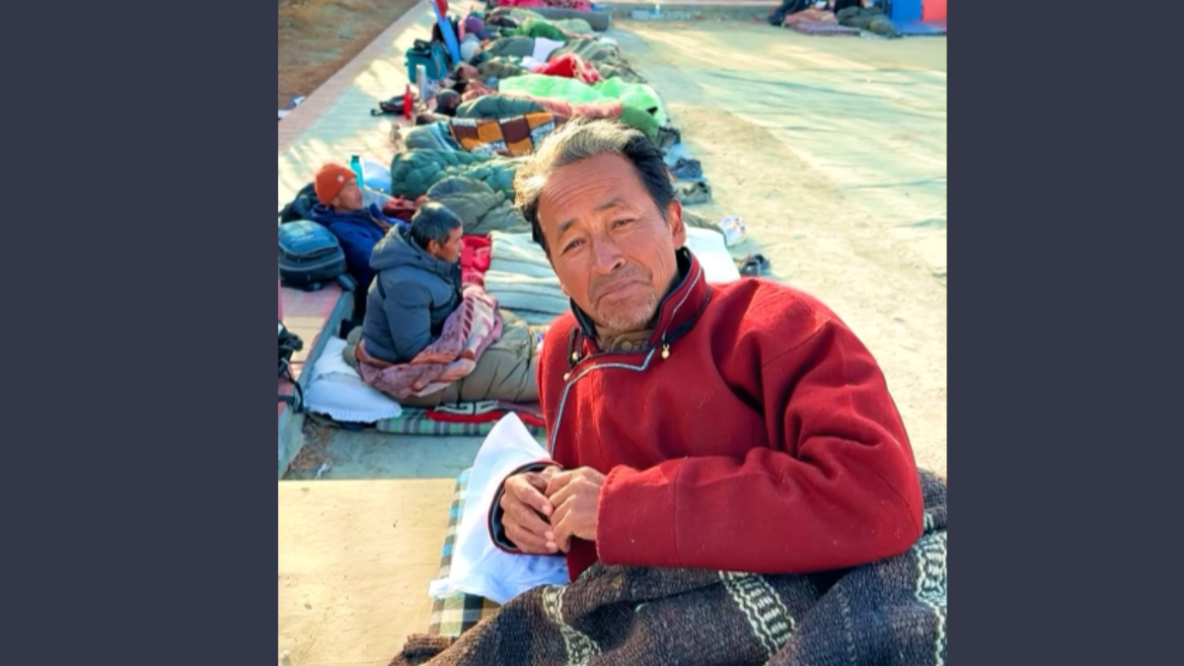
Today marks the 10th day of the hunger strike by Ladakhi activist Sonam Wangchuk, who has been on a 21-day hunger strike, protesting for environmental preservation, democratic rights, and the cultural identity of Ladakh and its people.
Wangchuk—whose life events inspired one of Bollywood’s greatest films ever made, “3 Idiots,” starring Aamir Khan—has established a relationship with people across the nation by frequently sharing videos on his social media pages, raising awareness and consciousness among people.
In the backdrop of aww-struck snow-capped peaks, Wangchuk began his hunger strike on 6th March following a massive rally in early February. Wangchuk, in his social media videos, is always seen greeting people and initiating conversations around the consequences of meddling with nature, which regularly garners hundreds of comments in support.
“Temperature this morning was -15 C. Some 110 people and I slept in the open in solidarity with our #glaciers and fragile #nature in high #Himalayas,” read the caption of Wangchuk’s 10th day video on Instagram.
In his video, he called out the politicians, saying that they only prioritise 5 years of ruling term and take no account of ecosensitive zones for making profits for a few rich industrialists.
“The local people are left face the consequences for generations. Then when human induced #disasters strike it costs more than those profits but this time it’s paid from tax payers money. This story has been repeated all over #Himalayas from #Himachal to #Uttranchal to #Sikkim. This could at best be called cleverness, not even intelligence,” he wrote in the post caption.
“We in #Ladakh believe that we need #wisdom not #cleverness,” it added.
On 3rd February, thousands of local residents gathered in the main city of Leh, the main city in Ladakh, to demand statehood and tribal status under the Sixth Schedule of the Indian Constitution. The rally was held under the leadership of the Leh Apex Body and Kargil Democratic Alliance, which represent the aspirations of Buddhist-majority Leh and Muslim-majority Kargil.
In an exclusive interview with India Today, Wangchuk explained the reasons behind his 21-day hunger strike amidst the biting cold of minus 17 degrees Celsius. He said, “It’s about environment. It’s about democracy.” Currently, Wangchuk is accompanied by locals from various villages, students, and activists on a rotation basis. Every day, around 150–200 people join Wangchuk at the protest site.
Protestors Demand
Thousands of protestors are demanding statehood and tribal status for Ladkha under the Sixth Schedule of the Indian Constitution. It all goes back to 2019, when Modi-led Central Government carved out Ladakh from Indian-administered Kashmir, promising greater autonomy and development. Even, BJP minister from the region, Arjun Munda also assured people of their demands.
However, as time passed, these promises began to ring hollow, and Ladakhis are feeling marginalised and betrayed.

“Not only once, they made the same promise twice. In 2019, it was among their top three promises, and in the 2020 Hill Council polls, it was their topmost promise,” Wangchuk told The Wire in a telephonic interview. So far nine rounds of talks have been held between officials of Ministry of Home Affairs and Ladakh’s representatives, without yielding any positive results. The last talk took place on 4th March.
“Our conversation with the government has failed multiple times because of its denial towards fulfilling out demand of statehood and legislature, which was promised in BJP’s 2019 Lok Sabha elections manifesto as well,” said Sajjad Kargili, a member of the Kargil Democratic Alliance.
Kargili, who just returned from Delhi after attending the talks with the government, said that, “Union Home Minister Amit Shah categorically refused both their main demands. While they were on the same page about jobs and inclusion of Ladakh cadre into Jammu & Kahmir’s PSC alongside granting 80% reservation for the Ladakhi people”. In the coming week, the Leh Apex Body and Kargil Democratic Alliance will sit down and discuss the future course of the protest, Kargili told SSZee Media.
What do locals fear
After the region was made a Union Territory, it came directly under the administration of New Delhi. One of the key grievances is the lack of representation and decision-making power in developmental projects that directly impact their lives. The proposed establishment of India’s first geothermal power plant and green hydrogen unit in Ladakh has raised concerns about the exploitation of natural resources and the environmental impact on the fragile ecosystem.
The sixth schedule of the Indian Constitution grants certain tribal areas the status of autonomous entities, empowering them to establish autonomous district councils and regional councils with legislative, executive, judicial, and financial authority.
However, the recent imposition of laws allowing outsiders to settle and engage in commercial activities in Ladakh has further exacerbated tensions. Referring to the recent news report on electoral bonds, Kargili pointed out that “BJP has received funds equal to Ladakh’s yearly fund. So, when, mega companies fund government, it automatically comes under pressure to grant them permission to carry out private projects.”
According to the latest data from 14th March shows that from April 2019 to January of 2024, the BJP emerged as the primary beneficiary of election bonds, significantly surpassing other political parties. The BJP alone accounted for nearly 48 percent of all election bonds cashed by parties until March 2023, totaling approximately Rs. 6,060 crore.
“People in Ladakh have this fear of exploitation of unexplored areas and fragile regions of Himalayas. They are insecure,” said Kargili adding that the Ladakh Autonomous Hill Development Council of Leh and Kargil—both were not consulted or taken on board while introducing the industrial policies in the region.
Ladakh’s Geography
Ladakh boasts a landscape adorned with majestic glaciers and glacial lakes, serving as vital reservoirs of water for the region. Often referred to as the “water tower of Asia,” the Himalayan glaciers, alongside the river basins they nourish, play a pivotal role in supplying water to a vast expanse of the continent. These glaciers stand as precious repositories of frozen freshwater, representing a scarce and invaluable resource in the global landscape. Referring to the last devastating monsoon in Himachal Pradesh, situation in Uttarakhand’s Joshimath, Kargili pointed out that climate change is visibly taking place in the Himalayan region.
“If the local bodies are not in authority to be consulted on public/private development projects for the region, it would be a threat to our environment,” he said.
According to the Scroll report, in total, 10 significant Memorandums of Understanding (MoUs) have been signed in the past two years, including plans for India’s first geothermal power plant in Puga Valley, a green hydrogen unit with the National Thermal Power Corporation, and proposals for seven hydropower projects along the Indus River and its tributaries.
Also, bids have been invited for solar projects, and there are plans to clear 157 hectares of forest land for electricity transmission lines by the Ladakh Power Development Department. As Ladakhis mobilise to make their voices heard, both locally and nationally, the struggle for autonomy and environmental protection takes on a new urgency.
And as Wangchuk’s hunger strike enters its 10th day, the strike symbolises not only the frustration of Ladakh’s people but also their determination to hold the government accountable for its negligence and indifference. This demand isn’t merely a quest for political power but a fervent desire to protect their land, forests, and water—the very essence of their existence.
About Author



Leave a Reply