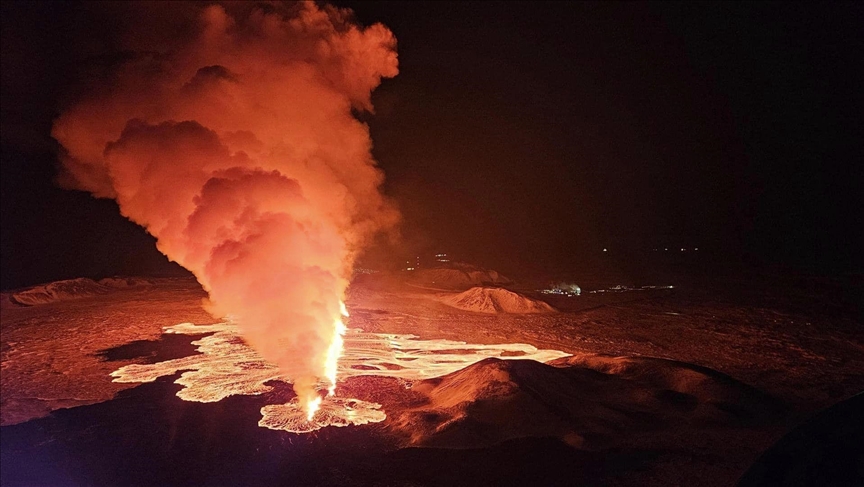
A state of emergency has been declared in southern Iceland after the fourth volcanic eruption on the Reykjanes Peninsula since December. Icelandic Meteorological Office (IMO) said in a statement that “a volcanic eruption has started between Stori-Skogfell and Hagafell on the Reykjanes Peninsula.”
The eruption, characterized by powerful and swift lava flows, commenced late on Saturday and has since continued with a “slow and steady” pace, according to IMO. According to reports, a helicopter was sent to narrow down the exact location of the new fissure by Iceland’s Department of Civil Protection and Emergency Management.
According to the IMO, lava had approached the eastern defenses surrounding Grindavik, a small town that has been mostly evacuated. Just after 22:00 GMT, “the southern lava front was just 200 metres [656 feet] from the barriers on the eastern side of Grindavik and moving at a rate of about one km per hour”, said IMO.
The water pipe services the Svartsengi power plant is a key geothermal facility providing hot water for much of the Reykjanes Peninsula. Kristin Jonsdottir, from the Norwegian Meteorological Agency, has warned of potential “dangerous” consequences if the lava reaches the sea as it flows southwards.
She explained that contact between alkaline lava and seawater could produce chlorine fumes and trigger minor explosions. Although no casualty has been reported, the authorities have evacuated hundreds of people from the Blue Lagoon thermal spa, one of Iceland’s top tourist attractions, according to the national broadcaster RUV. A workman was declared missing after falling into a fissure opened by the volcano.
Iceland’s main airport Keflavik remains unaffected as no disruptions were reported. While activity around the initial 3km (1.9 miles) long fissure has subsided, preparations for potential lava flow have been completed, according to Vídir Reynisson, director of Iceland’s civil defense.
The primary concern now is the impact on infrastructure, with pools of lava posing additional risks near defensive structures. Images and footage of the eruption depict clouds of smoke and glowing magma emanating from vents in the earth, reminiscent of the eruption that began on 8th December.
As the situation develops, authorities remain vigilant, closely monitoring the evolving volcanic activity in southern Iceland.
About Author




Leave a Reply