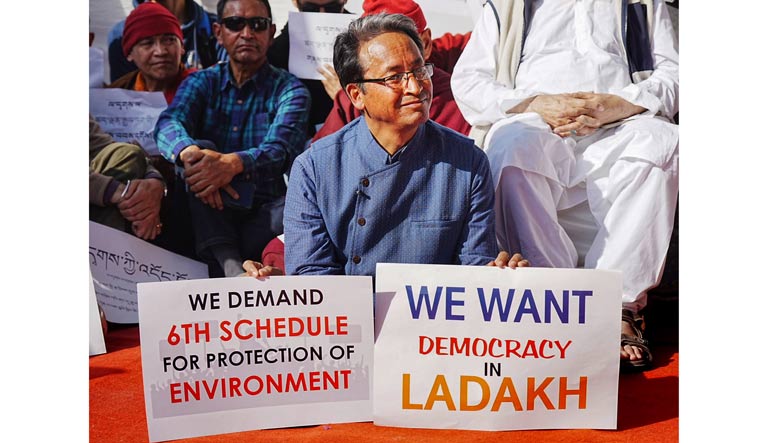
While India is set to practice world’s biggest festival of democracy, the people of Ladakh has been denied the basic right to protest against ignorant policies that threatens the fragile ecosystem of the region.
Recently, Pashmina March or padyatra towards the Chinese border in Ladakh was cancelled for the second time indicates a troubling trend of stifling dissent and ignoring pressing environmental concerns by the Modi government, particularly in the context of looming Lok Sabha elections.
Led by climate activist Sonam Wangchuk, the Pashmina Match, that was scheduled for 17th April was aimed at highlighting the loss of grazing lands for pashmina goats to big projects sanctioned by the central government in the region.
Understand Ladakh’s fight for the Sixth Schedule
Several development projects have bene sanctioned or underway in Ladakh, including seven hydropower projects with a total capacity of 2070 MW with a 13 GW solar power plant planned for the Pang area. Projects have been sanctioned to harness geothermal energy from Puga’s natural geysers to generate 100 MW of power. There are also considerations for mining exploration, particularly for resources like uranium and rare earth minerals. Bids have been requested for additional solar projects, and forest land clearance is sought for building electricity transmission lines.
Through a social media video, Wangchuk said, “LADAKH’S PASHMINA MARCH SUSPENDED AGAIN as government overreacts and threatens to destroy tourism in Ladakh.”
The Indian Union Government imposed section 144 for two days in the valley to stop the local leaders and people of Ladakh from taking out the first Pashmina March on 7th April.
Wangchuk in his Instagram video said that the people of Ladakh took a back step after the Apex Body informed that administration threatened to suspend internet services for two months and impose section 144 as tourism is one of the major sources of income for the people of Ladakh.
He further urged the Central government to take them (Ladak’s people) to borders if there has been no loss of land in Ladakh. Currently, people of Ladakh are continuing with Climate fast which was led by Wangchuk’s 21-day hunger strike in March.
Wangchuk was joined by thousands of Ladakhis in his peaceful protest demanding constitutional safeguards, including sixth schedule to protect Ladakh’s unique ecology and grant them autonomy over land-use decisions and curbing development by restricting unchecked industrial projects that could disrupt the delicate Himalayan balance.
However, the governments measures to prevent peaceful protests under the guise of maintaining order not only undermines the democratic rights of Ladakhis but also reflects a broader disregard for the region’s urgent climate activism.
Ladakh, situated near the sensitive Indo-China border, finds itself at the intersection of geopolitical interests and environmental challenges, yet the Centre’s response indicates a prioritization of optics over the livelihoods and environmental integrity of its people.
The abrupt imposition of prohibitory orders, threatening extended restrictions, and subsequent cancellation of the padyatras signify an overreach by the Union government, driven perhaps by a fear of unfavorable optics ahead of upcoming elections. By obstructing legitimate expressions of concern and dissent, the Modi government risks alienating local communities and undermining the principles of democracy it purports to uphold. Moreover, the government’s silence and inaction towards Ladakh’s burgeoning climate movement highlight a disconcerting blind spot in its policy agenda, where urgent environmental crises take a backseat to political expediency.
As we delve deeper into these developments, it becomes imperative to question the motives behind such actions and examine the broader implications for democratic norms, environmental justice, and the future of grassroots activism in sensitive border regions like Ladakh.
About Author




Leave a Reply