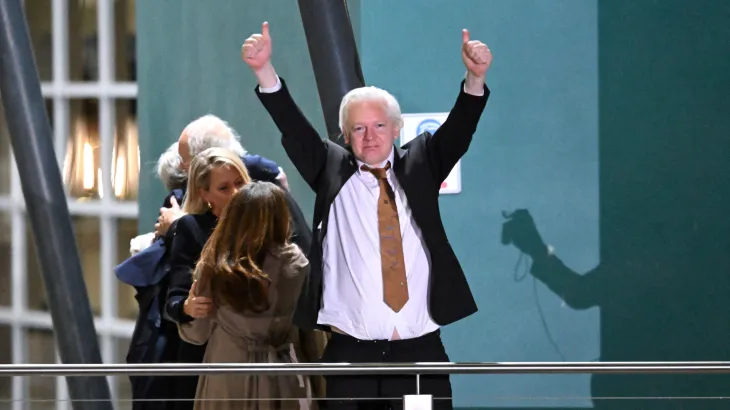
Wikileaks founder Julian Assange has returned to his home in Australia after a plea deal allowed him to walk free from a London prison to reunited with his wife and father, according to reports.
“Julian needs time to recover, to get used to freedom,” said his wife Stella Assange while addressing news conference shortly after her husband’s arrival. For the past 14 years, Assange has been fighting the legal battle with US officials who accused him of leaking classified documents, which they claim endangered lives.
The 52-year-old did not attend the news conference in Canberra, instead his lawyer and wife spoke on his behalf. “You have to understand what he’s been through,” said Mrs. Assange, adding that they need time to “let our family be a family.” The couple got married in London’s Belmarsh prison in 2022, and have two children together.
In 2010, Julian Assange’s legal saga began with a massive Wikileaks disclosure, when the website released a video from a US military helicopter showing civilians being killed in Baghdad. It also published thousands of confidential documents alleging unreported civilian deaths by the US military during the war in Afghanistan. These revelations sparked global reactions and intense scrutiny of American involvement in foreign conflicts.
Assange’s plea deal involved pleading guilty to one charge of conspiracy to obtain and disclose national defense information, rather than the 18 charges he originally faced. He formally entered the plea on the remote Northern Mariana Islands, an American territory in the Pacific, two days after leaving Belmarsh prison. In return, he was sentenced to time already served and released to fly home.
His lawyer, Jen Robinson, criticized the deal as the “criminalization of journalism” and warned it set a “dangerous precedent.” Mrs. Assange echoed this sentiment, expressing hope that the media would “realize the danger of this” conviction for “newsgathering and publishing information that was in the public interest.”
Ms. Robinson also shared details of a phone call between Assange and Australian Prime Minister Anthony Albanese, who played a crucial role in securing his release. Assange told the prime minister that he “saved his life,” a statement Ms. Robinson supported, saying, “I don’t think that’s an exaggeration.” She added, “This is a huge win that Australia stood up to an ally and demanded the return of an Australian citizen.”
Prime Minister Albanese held his own news conference on Wednesday, expressing his relief that the case is over and acknowledging the “considerable ordeal” Assange has been through.
Although earlier he said that he does not agree with everything Assange has done, but now emphasized that “enough was enough” and prioritized securing his release. Regarding potential impacts on US-Australia relations, he said, “We have a very positive relationship with the United States. I regard President Biden as a friend, I regard their relationship as being absolutely central.”
Assange has spent the last five years in London’s high-security Belmarsh Prison. In 2010, he faced separate rape and sexual assault charges in Sweden, which he denied. To avoid extradition to the US, he spent seven years in Ecuador’s London embassy. The Swedish authorities dropped the case in 2019, saying that the case took a lot of time since the original complaint.
Women’s rights groups in Sweden expressed disappointment that Assange never faced official questioning over the rape allegations. Clara Berglund, head of the Swedish Women’s Lobby, told Reuters, “It’s a chapter of shame and betrayal that ends with his release. This is about a case that takes place on the major political stages, and men’s violence against women is given incredibly little weight.”
About Author





Leave a Reply