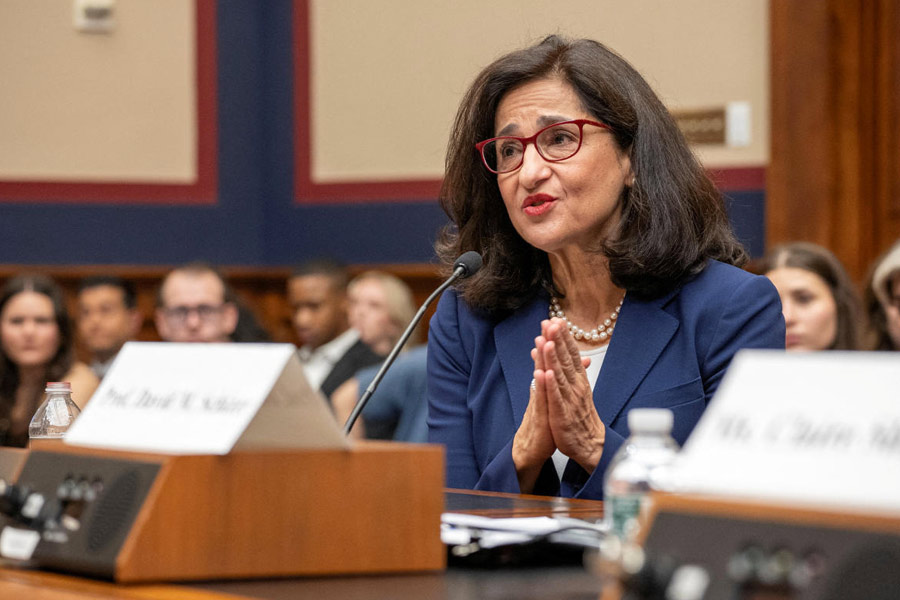
In a surprising turn of events, Minouche Shafik, the recently appointed president of Columbia University, has resigned from her post following intense criticism of her handling of pro-Palestine protests on campus. Shafik will now be joining the UK Foreign Office to work closely with Foreign Secretary David Lammy, focusing on reviewing the government’s approach to international development.
Minouche Shafik, a British-American citizen of Egyptian descent and a life peer in the House of Lords, served as vice chancellor of the London School of Economics from 2017 to 2023 before being appointed president of Columbia University in the United States. Her resignation Columbia University came after student unrest, particularly around the university’s response to Israel’s actions in Gaza, which sparked a series of protests on the New York campus earlier this year.
In her resignation announcement, Shafik cited the toll the controversy had taken on her family and expressed her desire to return to Britain. “Over the summer, I’ve been able to reflect and have decided that my moving on at this point would best enable Columbia to traverse the challenges ahead,” she wrote in an email to staff and students.
The protests, which saw students barricading themselves inside campus buildings, escalated in April when footage emerged of demonstrators breaking windows at the historic Hamilton Hall. The situation intensified when Shafik invited the New York Police Department onto campus to dismantle the occupation, a decision that was met with widespread backlash from both students and faculty.
Despite the protests being predominantly peaceful, the presence of riot police on campus, armed with zip ties and shields, led to multiple arrests and further fueled the controversy surrounding Shafik’s leadership. Her actions were condemned by both pro-Palestine and pro-Israel groups, with the latter accusing her of failing to protect Jewish students from rising anti-Semitic sentiments, despite many of the protesters themselves being Jewish.
Shafik’s leadership came under further scrutiny when she was called before Congress in April, where she faced accusations of allowing Columbia to become “a hotbed of anti-Semitism and hatred.” The situation worsened earlier this week when three deans at Columbia resigned after being implicated in exchanging anti-Semitic messages, further tarnishing the university’s reputation.
In her new role with the UK Foreign Office, Shafik will work on global poverty and sustainable development, areas she described as “lifelong interests.” She emphasized that this position would also allow her to reengage with legislative work in the House of Lords under the new UK government.
However, academics in the UK have expressed dismay at Shafik’s swift transition into a government role following her resignation. Professor Nicholas Guyatt of Cambridge University described her departure from Columbia as “long overdue,” while Professor Priyamvada Gopal criticized the decision, noting that her quick rehabilitation into a prominent role reflected poorly on the current Labour leadership.
Keely Hodgkinson Aims to Break Four-Decade-Old 800m World Record
Fresh off her Olympic gold victory in the 800 meters at the Paris Games, 22-year-old Keely Hodgkinson has set her sights on shattering one of athletics’ oldest records—the women’s 800m world record that has stood unchallenged for over 40 years.
The record, set by Czech runner Jarmila Kratochvílová in July 1983 at Munich’s Olympic Stadium, remains one of the most enduring in track and field. Kratochvílová’s time of 1:53.28 has withstood the test of time, becoming a symbol of athletic excellence.
Hodgkinson, who crossed the finish line in Paris with a time of 1:56.72, has seen her confidence soar after clocking an impressive 1:54.61 in London earlier this year. This remarkable performance has fueled her ambition to take on Kratochvílová’s record.
Speaking at the ‘Team GB’s Homecoming’ event held at Manchester’s AO Arena, Hodgkinson shared her aspirations: “It’s definitely something I’ve thought about since I raced in London. I think that record has stood for so long. It’s been a long time since anyone has hit [one minute] 53 seconds, so I’d love to do that. I think I can. I now believe I can do that.”
As Hodgkinson eyes this monumental challenge, another British athlete Georgia Bell is contemplating her own future in the sport. Bell has secured a bronze medal in the 1500 meters at the Paris Olympics, is still undecided about whether to fully commit to athletics as a career.
At 30 years old, Bell’s journey back to competitive running began just three years ago after she had stepped away from the sport. Balancing her athletic ambitions with her job at a cyber security software company in London, Bell is now at a crossroads.
“I’ve been on a break over the summer to focus on the Olympics and the plan is to go back in September,” Bell explained. “Work have been super-supportive and we’ll see what happens. I think it will be really difficult to balance both. So it’s something I’m going to think about.”
Meanwhile, another British athlete is celebrating a groundbreaking achievement. Nineteen-year-old Toby Roberts made history by becoming the first Briton to win an Olympic medal in sports climbing, securing gold in the boulder and lead event in Paris.
Reflecting on his victory, Roberts described the experience as surreal: “Things had been a bit of a blur since, and it still feels surreal to have this medal round my neck right now. I’ve always seen myself as a climber who loves competing, and to be among all these great athletes in this environment feels like a dream really.”
As these athletes navigate the highs of Olympic success and the uncertainties of their future paths, their stories continue to inspire and captivate the world of sports.
About Author





Leave a Reply