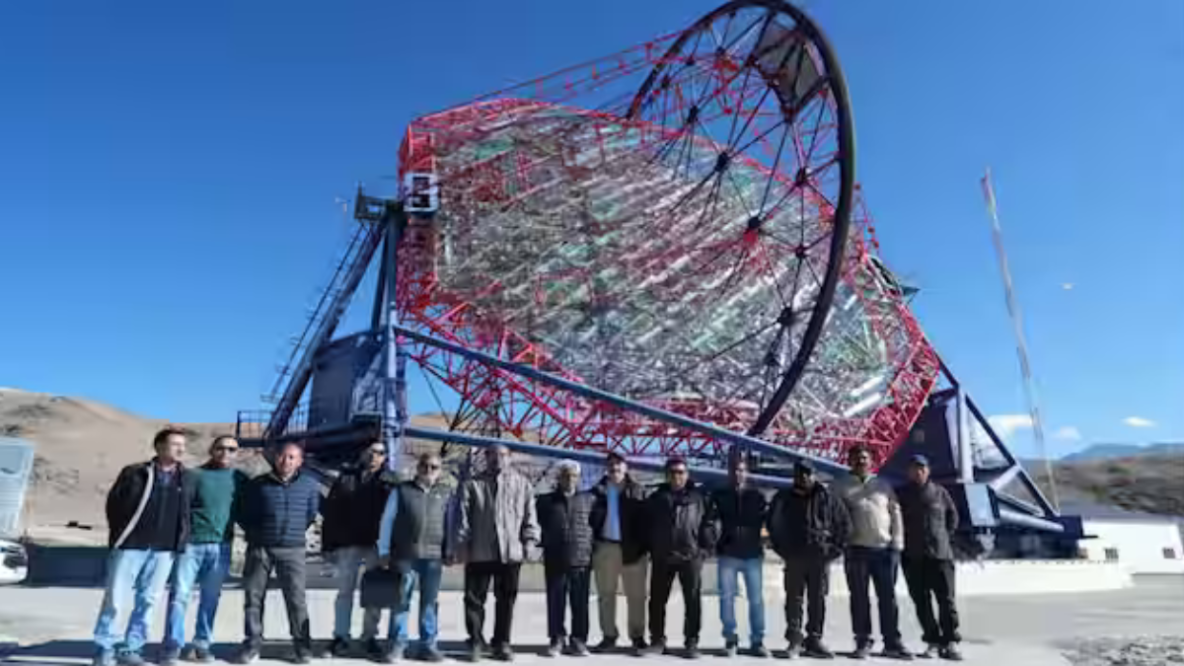
India has launched Asia’s largest imaging Cherenkov telescope, the Major Atmospheric Cherenkov Experiment (MACE), at Hanle in Ladakh. Standing at an altitude of nearly 4,300 meters, MACE is now the highest Cherenkov telescope in the world. Built indigenously by the Bhabha Atomic Research Centre (BARC), in partnership with Electronics Corporation of India Ltd (ECIL) and other Indian industries, the observatory is set to propel India to the forefront of global cosmic ray research.
The observatory was inaugurated by Dr. Ajit Kumar Mohanty, Secretary of the Department of Atomic Energy (DAE) and chairperson of the Atomic Energy Commission. During the ceremony, Dr. Mohanty emphasized the importance of MACE, stating that it will significantly contribute to both scientific research and the socio-economic development of Ladakh.
MACE enables the study of high-energy gamma rays, offering scientists a unique opportunity to explore the most energetic phenomena in the universe, such as supernovae, black holes, and gamma-ray bursts. This ambitious project will strengthen India’s position in the global scientific community by advancing research in cosmic rays.
The telescope has an impressive 21-meter diameter and weighs 175 tonnes. Its 356-square-meter reflector surface consists of 1,424 diamond-turned metallic mirror facets, aligned with extreme precision using 712 actuators. MACE also houses 1,088 photomultiplier tubes and 68 camera modules, designed to capture even the faintest gamma-ray flares.
Constructed with lightweight, temperature-resistant materials, the telescope’s ultra-fast backend electronics feature nanosecond digitisation, specifically designed for low-power consumption and operations in Hanle’s cold temperatures. MACE has already made early breakthroughs by detecting gamma-ray flares from sources as far as 200 million light-years away.
Gamma rays, which are absorbed by Earth’s atmosphere, create high-energy particles that emit Cherenkov radiation—similar to a sonic boom—as they travel faster than light through the atmosphere. MACE’s mirrors and cameras capture this radiation, allowing scientists to trace it back to its cosmic source.
Hanle was chosen for MACE due to its exceptionally low levels of light pollution and ideal conditions for observing gamma rays. Its unique longitudinal position also allows for the monitoring of cosmic sources that are inaccessible from other observatories around the world.
About Author





Leave a Reply