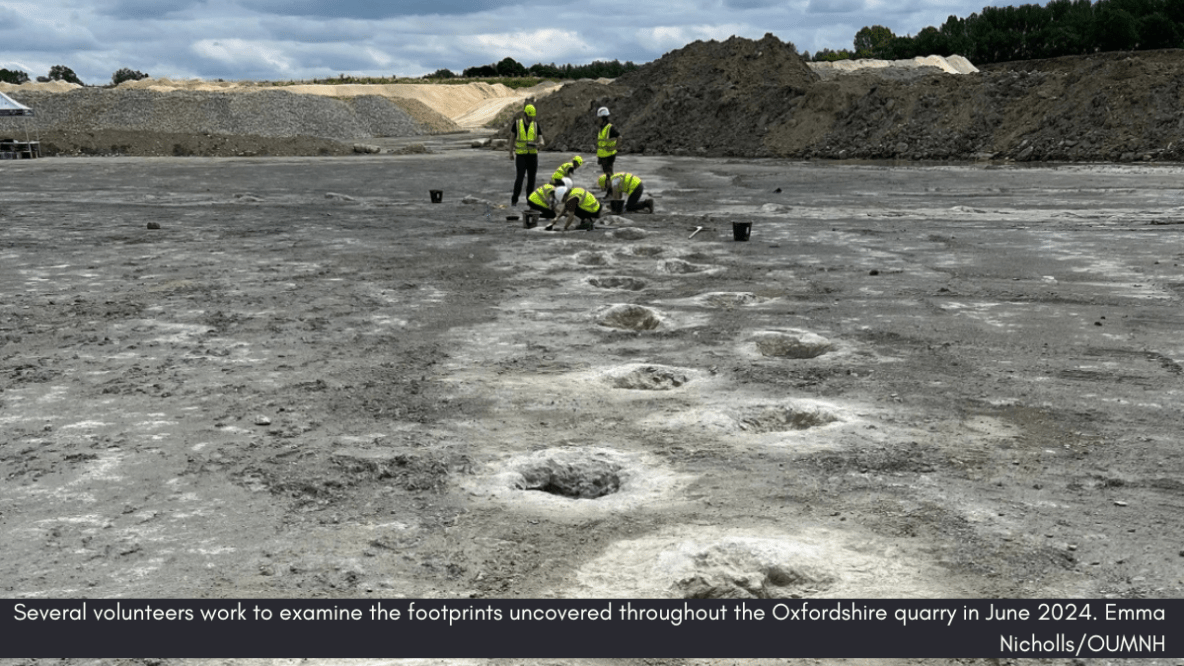
In a groundbreaking discovery at Dewars Farm Quarry in Oxfordshire, England, scientists have unearthed nearly 200 dinosaur footprints dating back 166 million years to the Middle Jurassic Period. The site, now dubbed the “dinosaur highway,” represents the largest known dinosaur track site in the United Kingdom.
The remarkable find was first noticed in 2023 by quarry worker Gary Johnson, who observed “unusual bumps” on the ground while extracting limestone. His discovery led to an extensive excavation effort involving around 100 volunteers from the University of Birmingham and the University of Oxford. The team worked tirelessly over a week in June to document the expansive site.
The discovery holds special significance as it coincides with the 200th anniversary of the first-ever described dinosaur, the Megalosaurus, also found in Oxfordshire in 1824. Kirsty Edgar, a professor of micropaleontology at the University of Birmingham, highlighted the region’s rich legacy of dinosaur tracks and fossils. “There’s a really long legacy in this area of exciting dinosaur tracks and body fossils,” she said.
This new site connects to a previously discovered dinosaur path in the same quarry from 1997, now inaccessible. Advancements in technology will allow scientists to glean new insights into dinosaur behavior, movements, and social dynamics. Five extensive trackways were uncovered, with the longest continuous pathway stretching over 150 meters. Most of these tracks were from sauropods, large herbivorous dinosaurs like the Cetiosaurus, which could reach up to 18 meters in length.
Lawrence Tanner, a paleoecologist at Le Moyne College, compared sauropods to modern elephants due to their massive size and diet. He noted that the tracks, primarily from the hind legs, showed similarities to how elephants move. “The general rule of locomotion is that the faster the animal is moving, the farther apart the footprints will be,” Tanner explained.
The fifth pathway contained tracks from the Megalosaurus, a predatory dinosaur with distinctive three-toed feet, measuring up to 9 meters long. Researchers determined that these dinosaurs were moving northeast at a pace comparable to a human walking speed.
The intersecting paths of the Megalosaurus and the sauropods suggest predator-prey interactions. While the exact destinations of these dinosaurs remain speculative, Tanner suggested they might have been navigating shorelines or searching for food.
The preservation of this trackway was made possible by the unique Jurassic Period conditions, with soft sediment and water creating perfect conditions for footprint conservation. Edgar likened the ancient environment to the Florida Keys, where carbonate mud banks and nearby water sources played a crucial role.
Over 20,000 images of the footprints were captured using aerial drone photography, allowing researchers to create detailed 3D models. These models will be made available to the public, providing an unprecedented look at the site.
The research team is committed to ongoing exploration as the quarry continues its operations. “As quarrying continues, as long as we can, I think we’ll be continuously evaluating and working with the quarry workers as new areas are exposed,” Edgar said.
The findings from this significant discovery are expected to be published within the next year, offering new insights into the lives of these ancient giants.
#DinosaurHighway #JurassicDiscovery #Paleontology #OxfordQuarry #DinosaurTracks #FossilFinds #PrehistoricPathways #Sauropods #Megalosaurus #3DModeling #ScienceDiscovery #AncientFootprints
About Author





Leave a Reply