The majestic Himalayas, known for their towering peaks and awe-inspiring beauty, are the result of a colossal geological clash between the Indian and Eurasian tectonic plates, a process that has been ongoing for around 60 million years. However, the true intrigue lies beneath the surface, where complex tectonic forces continue to reshape the landscape.
Continental plates, unlike their oceanic counterparts, are thick and buoyant, resisting subduction into the Earth’s mantle. This characteristic has spurred debate among scientists about how the Indian Plate behaves in its persistent collision with Eurasia. One theory suggests the Indian Plate resists subduction entirely, sliding horizontally beneath Tibet. Another posits that the upper, buoyant part crumples, allowing the denser lower portion to subduct.
A recent breakthrough offers a fresh perspective. Analyzing earthquake waves beneath Tibet and studying specific gases rising to the surface, researchers have proposed a novel theory. They suggest that part of the Indian Plate is “delaminating,” with the denser lower section peeling away from the buoyant upper portion as it slides beneath the Eurasian Plate. This process appears to involve a vertical fracture or tear at the boundary between the separated sections of the plate.
“We didn’t know continents could behave this way, and that is, for solid earth science, pretty fundamental,” said Douwe van Hinsbergen, a geodynamicist at Utrecht University.
This pioneering study, presented at the American Geophysical Union conference and available as a preprint online, could significantly enhance our understanding of the Himalayas’ formation and aid in assessing regional earthquake risks. However, caution is advised, as Fabio Capitanio of Monash University noted, “It’s just a snapshot,” acknowledging the uncertainties and limited data. Yet, he affirmed the importance of this research in advancing our understanding of Earth’s dynamic processes.
The concept of tectonic plates “unzipping” has intrigued scientists for years. These plates, composed of a buoyant crust and denser upper mantle rock, may split under compression and thickening. Until now, such phenomena were mainly studied within continental plates’ interiors and simulated via computer models. This study is the first to observe this behavior in a descending plate.
The Himalayan collision zone is particularly suited for exploring tectonic plate tearing. Before the collision, the Indian Plate exhibited variations in thickness and composition, which likely influenced the crescent shape of the 2,500-kilometer-long Himalayan front. Peter DeCelles, a geologist at the University of Arizona, likened the ancient plate to a manta ray, with thin wings of oceanic crust flanking a thick central continental portion. The oceanic slabs subducted under Eurasia, while the thick continental crust collided forcefully, giving rise to the mountain range.
Multiple stresses from varying subduction speeds likely caused numerous tears in the Indian Plate. Simon Klemperer, a geophysicist at Stanford University, highlighted the growing body of evidence for multiple tears, noting it has become a “cottage industry” among scientists.
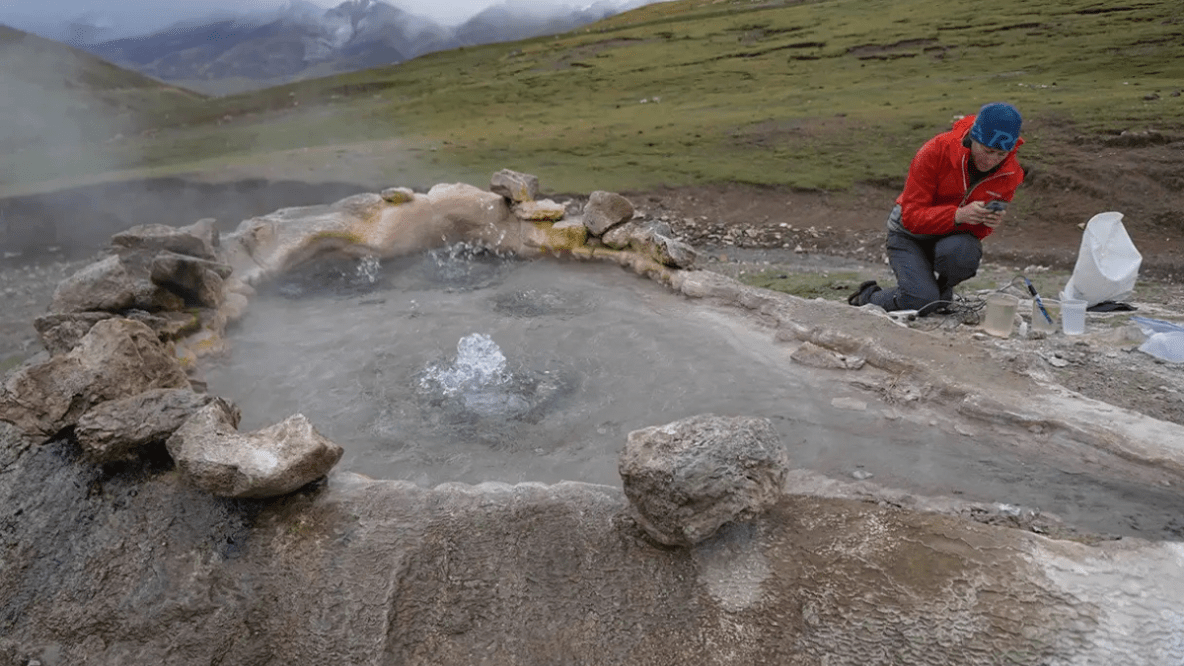
Focusing on a turbulent region in northeastern India near Bhutan, Klemperer’s research involved years of collecting helium isotope measurements from Tibetan springs. Helium-3, a primordial Earth isotope, indicated mantle rock presence, while its absence suggested gases from buried crust. The team observed a striking pattern: springs south of a certain line showed crustal signatures, while those to the north exhibited mantle fingerprints. Intriguingly, three springs south of this line near Bhutan’s eastern border also displayed mantle signatures, hinting at delamination and mantle rock filling the gap.
Earthquake wave analysis supported this hypothesis, revealing two distinct subsurface blobs, suggesting the lower Indian Plate was detaching from the upper section. Further analysis indicated a tear on the delaminated slab’s western edge, where mantle rock appeared to be flowing into the gap.
Anne Meltzer, a seismologist at Lehigh University, emphasized the importance of understanding continental collisions, which have shaped most of Earth’s landmasses. This knowledge is crucial for assessing earthquake hazards along ancient fault lines.
Klemperer suggested the proposed tear might influence current earthquake hazards in Tibet, potentially linked to a deep fracture in the Tibetan Plateau known as the Cona-Sangri rift. Douwe van Hinsbergen noted that such tears and delamination could affect stress buildup, influencing earthquake likelihood.
Despite the complexities of studying these ancient collisions, scientists remain eager to unravel Earth’s billion-year-old history. Each discovery brings us closer to comprehending the intricate processes that have sculpted our planet.
About Author





Leave a Reply