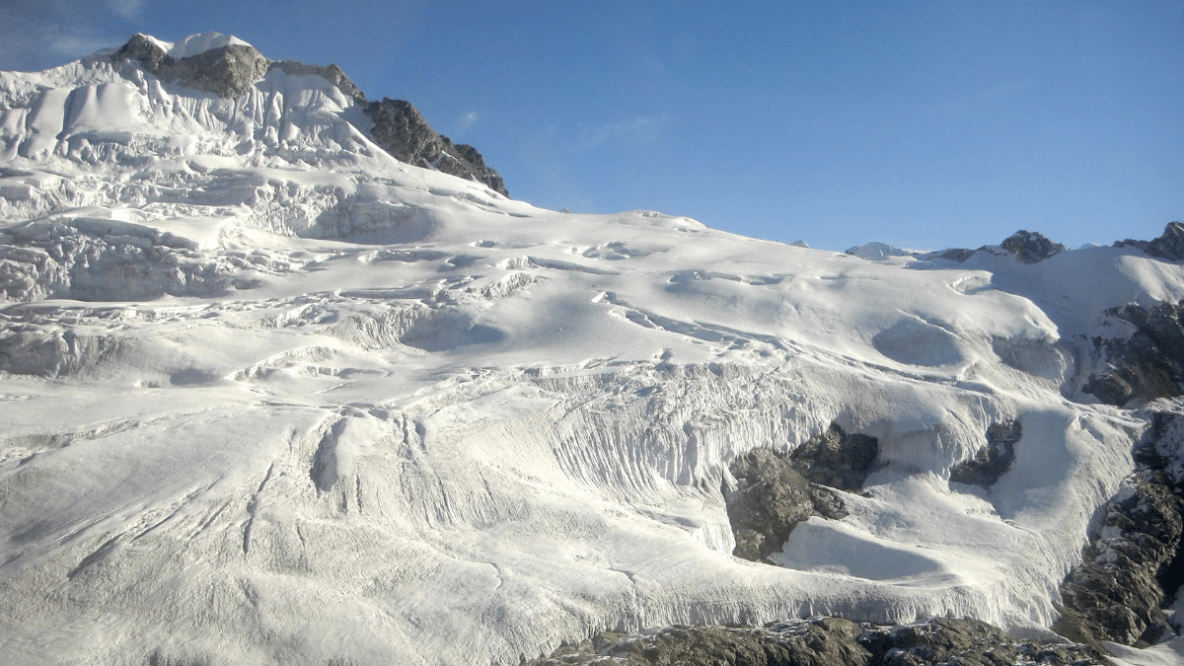
The Yala Glacier, a critical glacial body in Nepal’s Langtang National Park, is rapidly shrinking and may disappear entirely by the 2040s due to accelerated climate change, scientists warn. This stark projection highlights the devastating impact of global warming on the Himalayan cryosphere and underscores the urgent need for global and regional climate action.
Since 1974, the Yala Glacier has retreated by a staggering 680 meters, equating to a 36% reduction in its overall area. According to scientists at the International Centre for Integrated Mountain Development (ICIMOD), by 2011, the glacier’s elevation had dropped from 5,170 meters to 5,750 meters, demonstrating the alarming pace of its decline.
Yala Glacier has a precarious status as it is the only glacier in the entire Himalayas to be included in the Global Glacier Casualty List—an initiative launched in 2024 to identify critically endangered or vanished glaciers worldwide, which was a collaboration between Rice University, University of Iceland, Iceland Glaciological Society, World Meteorological Organization (WMO), World Glacier Monitoring Service, and UNESCO.
The potential disappearance of the Yala Glacier is more than an environmental concern; it has profound implications for water security across the region. The Hindu Kush Himalaya region, which depends heavily on glacier-fed water systems, is warming at twice the global average rate. This puts the water supply for an estimated 240 million people at risk, according to experts.
“In 2023, glaciers suffered largest mass loss in the five decades of record keeping. It was the second consecutive year in which all regions in the world with glacier reported ice loss,” said scientists at WMO and UNESCO.
Moreover, the rapid melting of glaciers like Yala contributes to the formation of unstable glacial lakes. These lakes pose a serious threat to downstream communities through glacial lake outburst floods (GLOFs), which can unleash catastrophic flooding with little warning. The increased frequency of such events is a sobering reminder of the urgent need for better monitoring and mitigation strategies.
Globally, the crisis facing glaciers has prompted renewed attention. The United Nations has declared 2025 the International Year of Glaciers’ Preservation, an initiative aimed at raising awareness and providing critical hydrological and climate services to glacier-dependent regions. Starting the same year, March 21 will be observed annually as the World Day for Glaciers, a step toward prioritizing glacier conservation on the global agenda.
Regionally, efforts are also underway to address the growing challenges. India has launched the National Mission for Sustaining the Himalayan Ecosystem, focusing on preserving the region’s fragile environment. The Indian National Centre for Ocean Information Services (INCOIS) has also been instrumental in monitoring glacier-related events and issuing alerts for potential GLOFs, reflecting the need for proactive measures in neighboring countries.
About Author




Leave a Reply