United States President Donald Trump has announced sweeping new tariffs on steel and aluminium imports, imposing a 25% levy on all steel and aluminium entering the country, reflecting his administration’s aggressive trade policies. Trump said the official announcement on steel and aluminium tariffs would come on Monday, with additional reciprocal tariffs to follow later in the week.
“Very simply, it’s if they charge us, we charge them,” Trump told reporters aboard Air Force One. “If they are charging us 130 percent and we’re charging them nothing, it’s not going to stay that way.”
The decision raises concerns for top US metal suppliers, including Canada, Mexico, South Korea, Vietnam, Brazil, and China. Canada, the largest exporter of both steel and aluminium to the US, quickly pushed back, highlighting the deep economic ties between the two nations.
“Canadian steel and aluminium support key industries in the US from defence, shipbuilding and auto,” said Canadian Minister of Innovation Francois-Philippe Champagne in a post on X. “This is making North America more competitive and secure. We will continue to stand up for Canada, our workers, and our industries.”
Trump also signalled that his administration would introduce reciprocal tariffs on all nations imposing levies on US goods. These tariffs are expected to match the rates levied by each country, a move that could provoke further trade disputes.
Australia Seeks Exemption Amid Growing Concerns
Australian Prime Minister Anthony Albanese confirmed he would discuss the tariffs with Trump, emphasizing the importance of Australia’s steel and aluminium exports to US industries. Trade Minister Don Farrell also made a case for Australian exemptions, stating that its steel and aluminium contribute to “thousands of good-paying American jobs” and play a vital role in shared defence interests.
“We will continue to make the case for Australia’s national interest with the US administration and, what’s more, we regard this as also being in the US national interest as well,” Albanese told parliament. “Because tariffs of course don’t tax us, they tax the purchasers of our products.”
Australia exported approximately $237 million worth of steel to the US in 2023 and around $275 million worth of aluminium the following year, according to UN trade data. Whether Australia will secure an exemption remains unclear, with Trump’s rhetoric suggesting a blanket approach to all trading partners.
Trump’s Tariff History and Expanding Trade Disputes
Trump’s latest tariff threats come after his previous announcement of a 25% tariff on all Canadian and Mexican goods, as well as a 10% tariff on Chinese imports. However, he later delayed the Canadian and Mexican measures after securing commitments to curb illegal drugs and undocumented migration at the US border.
His latest remarks also suggest that the European Union could soon face similar tariffs. Trump previously claimed that the EU imports “almost nothing” from the US while enjoying unrestricted access to the American market. His trade war with China is already escalating, with Beijing imposing retaliatory tariffs on US goods.
Implications for the UK and Global Markets
In the UK, steel and aluminium exporters currently benefit from a tariff-rate quota (TRQ) arrangement, allowing for duty-free exports up to a specified volume. Under this system, the UK can export up to 500,000 metric tonnes of steel and 21,600 metric tonnes of aluminium to the US annually without tariffs. However, uncertainty looms over whether the UK will maintain its exemption under Trump’s new policies.
Mark Stone, US correspondent for Sky News, explained, “Trump has imposed steel tariffs before. In 2018, during his first term, he introduced tariffs of 25% and 10% respectively on certain imports of steel and aluminium to the US. However, these were replaced with a tariff rate quota (TRQ) for the UK in 2022, allowing for duty-free export.”
The stock market has already reacted, with shares of Asian steelmakers falling on Monday, except for those with US operations. Meanwhile, German Chancellor Olaf Scholz has warned that the EU is prepared to retaliate swiftly should Washington proceed with tariffs on European goods.
Trump’s Gulf of America Declaration and Canada Controversy
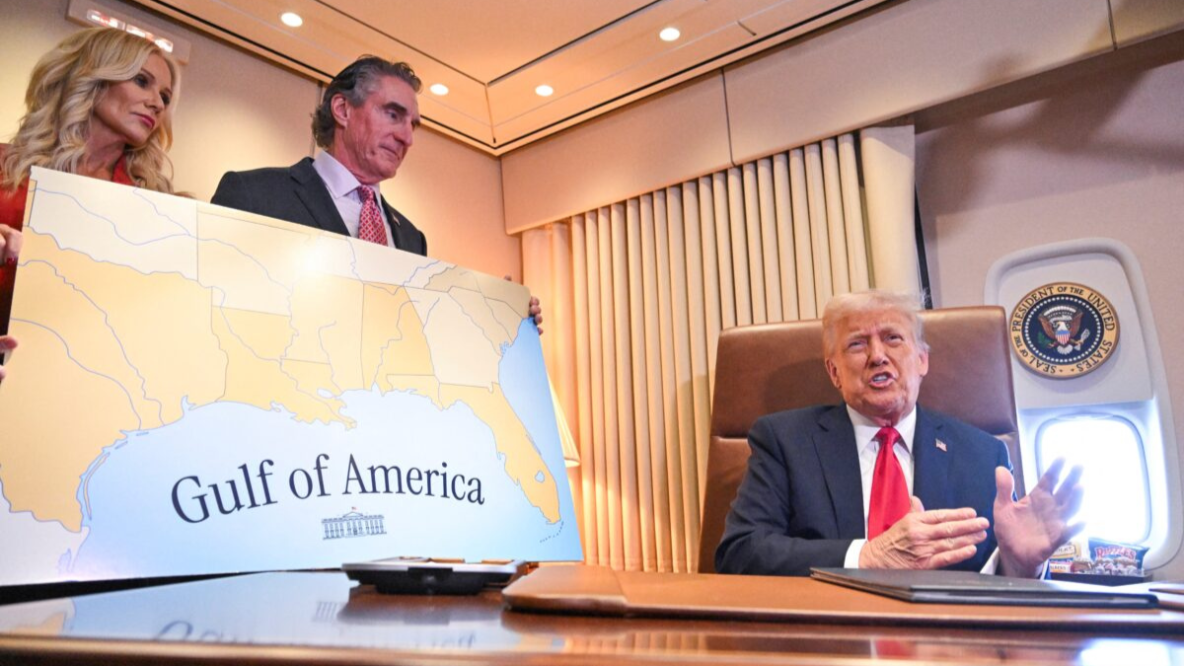
Beyond trade, Trump made headlines aboard Air Force One by signing a proclamation declaring 9 February, 2025, as the first-ever “Gulf of America Day,” a symbolic renaming of the Gulf of Mexico. He posed for a photo with a newly altered map reflecting the change.
Trump also stirred controversy with his renewed call for Canada to become “the 51st state.” In an interview with Fox News, he said, “I think Canada would be much better off. We lose $200bn a year with Canada. And I’m not going to let that happen. It’s too much.”
“Why are we paying $200bn a year essentially in subsidy to Canada? Now, if they are a 51st state, I don’t mind doing it.”
His comments come amid ongoing trade tensions with Canada, reinforcing his administration’s hardline stance on economic policy. Trump also reaffirmed his support for Elon Musk, who is leading efforts to streamline government bureaucracy under the newly formed Department of Government Efficiency (DOGE), aimed at cutting federal workers and regulatory programs.
With Trump doubling down on protectionist policies and trade disputes escalating globally, the coming weeks are set to test international alliances and economic stability.
About Author





Leave a Reply