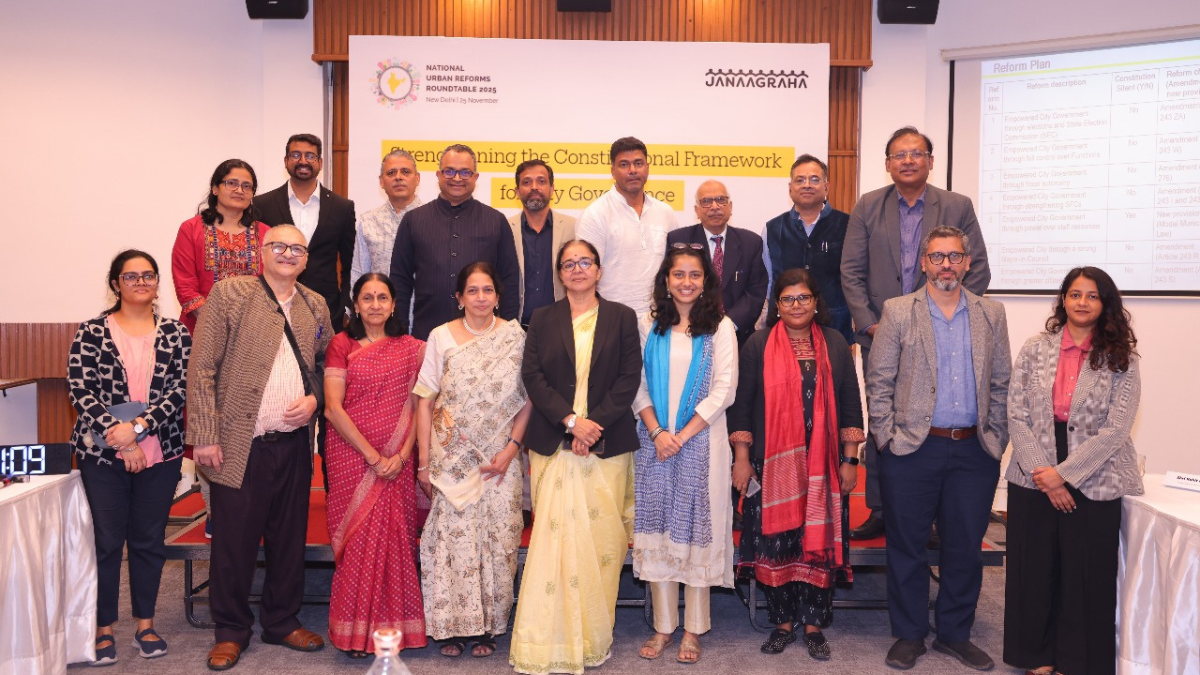
On the eve of Constitution Day, several urban policy experts, elected representatives and civil society members convened in New Delhi for a roundtable discussion on “Strengthening the Constitutional Framework for City Governance.” The meeting, organised by the Janaagraha Centre for Citizenship and Democracy, reviewed the performance of the 74th Constitutional Amendment Act (74th Amendment) and examined ways to address the gaps in its implementation.
Enacted in 1992, the 74th Amendment introduced Part IX-A into the Constitution, mandating democratic decentralisation and granting Urban Local Governments (ULGs) the authority to function as independent institutions of self-government. Since then, India’s economic landscape has transformed significantly: GDP has risen fifteen-fold from $270 billion to over $3.7 trillion, while the urban population has expanded from 217 million to an estimated 520 million.
However, discussions at the roundtable highlighted how governance reforms have failed to keep pace with economic and demographic growth. Local governance remains constrained, with over 60 per cent of ULGs across 17 states experiencing delays in elections. On average, only five of the 18 functions under the Twelfth Schedule are effectively devolved to city governments. In addition, 13 out of 18 states continue to hold overriding powers such as suspension of ULG resolutions and approval of municipal budgets. Only nine of fifteen states have functional ward committees in at least one ward, and 67 per cent of states with metropolitan regions have yet to constitute Metropolitan Planning Committees.
Participants stressed that India now faces the urgent challenge of enabling its cities to deliver a quality of life that matches global standards. With the national ambition of achieving developed-nation status by 2047, rapid urbanisation coupled with climate risks has made governance reform a pressing necessity.
Key Insights and Reform Priorities
The roundtable concluded that realising the full potential of the 74th Amendment requires immediate and comprehensive reforms. Among the core recommendations were empowering State Election Commissions to ensure timely municipal elections, instituting uniform five-year mayoral terms, and fully devolving all 18 constitutional functions to city governments. Participants also emphasised expanding the Twelfth Schedule to include climate change, disaster management and SDG monitoring.
Other proposals included differentiated governance frameworks tailored to city size and complexity, operationalising Metropolitan Planning Committees for regional coordination, ensuring accountability of parastatal agencies to elected bodies, and institutionalising citizen participation through ward committees, area sabhas and formal involvement of Resident Welfare Associations (RWAs).
Reflecting on the discussions, Dr Beena Philip, Former Mayor of Kozhikode and Vice President of the All India Council of Mayors (AIMC), said, “It was a thought-provoking roundtable which encouraged participants to rethink and deliberate on how we can strengthen urban governance by reworking the constitutional framework. It has been 33 years since the 74th Amendment was implemented. Since then, urban population has significantly grown and therefore it’s high time to work towards building cities of the future.”
Anand Iyer, Chief Policy and Insights Officer at Janaagraha, underlined the need for stronger city institutions, “At the root of several issues that plague our cities today (to mention only increasing air pollution and flooding) is fragmented control and a weakened city government. While state governments can take steps to empower cities, suitable support from the union — like strengthening the 74th Constitutional Amendment for contemporary times — can really help states. The best time for this, towards developed cities, can still be NOW!”
The event concluded with a renewed call for coordinated reforms aimed at empowering city governments and improving the quality of urban life across India.
About Author



Leave a Reply