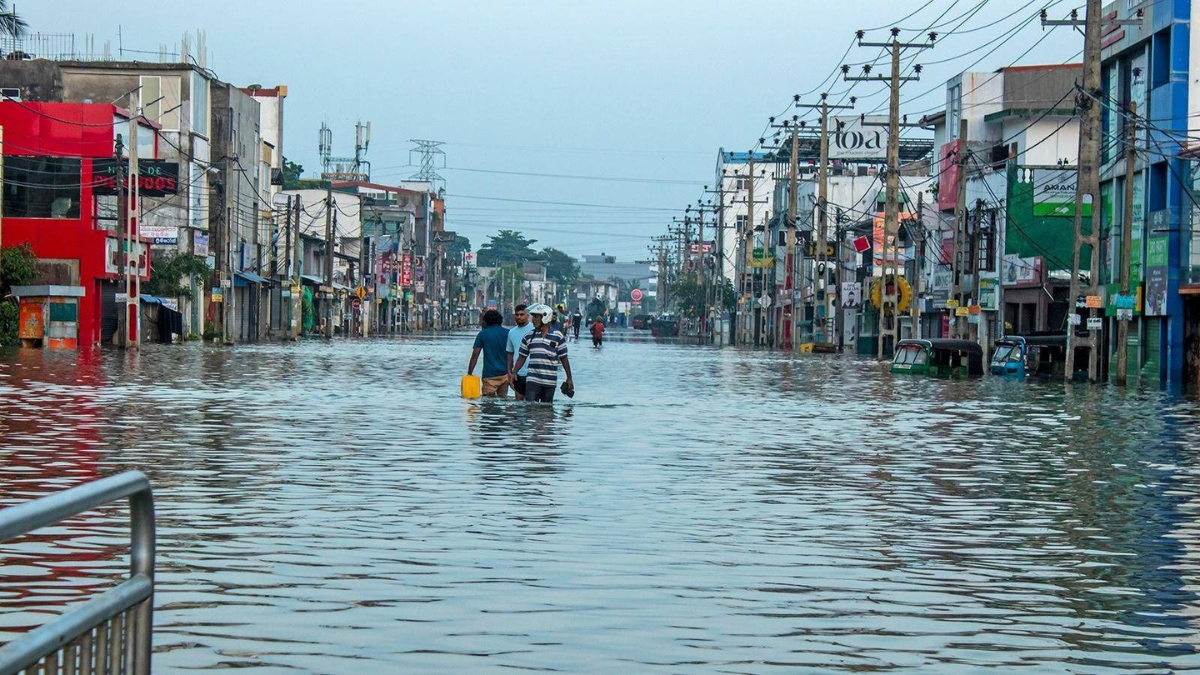
A new rapid analysis by the World Weather Attribution (WWA) group concludes that human-induced climate change significantly intensified the extreme rainfall that triggered catastrophic flooding and landslides across Sri Lanka, Indonesia, Malaysia and southern Thailand in late November 2025. The study examines the heavy five-day rainfall associated with Cyclonic Storm Ditwah in Sri Lanka and Cyclonic Storm Senyar over the Malacca Strait.
According to the findings, heavy multi-day rainfall events in Sri Lanka are now 28% to 160% more intense compared to a world without the 1.3°C of global warming already experienced. The rainfall associated with Ditwah corresponds to a 1-in-30-year event in today’s climate. In the Malacca Strait region, extreme rainfall linked to Senyar reflects a 1-in-70-year event, intensified further by concurrent La Niña conditions and a negative Indian Ocean Dipole, which together contributed an additional 5% to 13% to rainfall totals.
Sea surface temperatures in the North Indian Ocean were 0.2°C higher than the 1991–2020 average, adding more energy for storm development and evaporation. Without the warming trend linked to global temperature rise, those sea surface temperatures would likely have been about one degree cooler and closer to historical norms.
The study highlights how geographical features shaped the severity of impacts. Sri Lanka’s steep central highlands channelled intense rainfall into low-lying floodplains, overwhelming rivers and triggering widespread landslides. In the Malacca Strait region—comprising volcanic islands, deltas and poorly drained plains—persistent rainfall quickly translated into flash floods and slope failures.
WWA researchers found that while observational datasets consistently show a strong upward trend in extreme rainfall intensity across both regions, most climate models failed to capture these increases. The models also struggled to represent the influence of La Niña and the Indian Ocean Dipole. This mismatch suggests that key atmospheric processes affecting heavy rainfall over small island regions may be systematically under-represented in current modelling systems, preventing researchers from reaching a fully quantified attribution conclusion.
Across Sri Lanka and Indonesia, the unusually intense rainfall caused extensive infrastructure damage, displacement and disruption of essential services. In Sri Lanka alone, over 600,000 families were displaced and more than 277,000 buildings were inundated. Indonesia reported over 1.5 million people affected, with Sumatra experiencing the worst impacts.
The study concludes that while natural variability contributed to the heavy rainfall, the dominant signal is the clear trend toward increasingly intense extreme rainfall events in a warming world, leaving densely populated regions around the Indian Ocean more exposed to devastating floods in the years ahead.
Watch the full podcast here:
About Author





Leave a Reply